
Which Westmoreland County Deed Records to Read
The Westmoreland Clerk's land-record index reaches beyond simple purchase deeds. One entry may transfer land outright. Another may secure a debt. A third may release an interest or record a plat or court reference. Keep the instrument type with each result. The label tells you what the document actually did to the property.
| Instrument group | What it records | Why it matters to a chain |
|---|---|---|
| Deed or fiduciary deed | A conveyance by named parties, including an executor or administrator | Identify grantor, grantee, date, and land description |
| Deed of trust or mortgage | A recorded security interest | It is not itself the ownership transfer |
| Release, satisfaction, or assignment | A later action tied to an earlier instrument | Search it separately before treating an encumbrance as cleared |
| Plat or line adjustment | Recorded parcel or subdivision geometry | Compare lot, boundary, and deed references |
| Judgment, lien, or lis pendens | A recorded notice or claim linked to property | Check the underlying court file where needed |
Older transfers can also be deeds of gift, will-related conveyances, partition instruments, chancery orders, or boundary adjustments. Do not flatten them into sale entries. Treat each type for what it is when you rebuild a Westmoreland County chain.
The Westmoreland County Grantor and Grantee Fields
Virginia Secure Remote Access is the statewide land-record route. Westmoreland maintains a computerized index within it. The Supreme Court of Virginia describes party-based access. The county's live search controls are dynamic, so the exact screen options can vary. Search both directions when building a chain: a current grantee's deed names the prior grantor, and that grantor becomes the next grantee in an older search.
| Index item | What to capture | Local verification note |
|---|---|---|
| Indexed party | Grantor and grantee names | Search spelling variants and entities |
| Instrument | Document type | Exact dropdown inventory is unknown |
| Date | Recording date or date range | Use it to narrow a chain |
| Reference | Book/page or document number | Keep the reference with the legal description |
| Image | Image link if enabled | Access can depend on Clerk authorization |
The land index is not a civil docket. A lis pendens or judgment may appear there. Pleadings and a final order usually require a separate request to the court file.
Westmoreland County SRA Index Access and Deed Images
Virginia's SRA system separates index access from document images. Free index-only access exists where a Clerk enables it. Images are another matter. They go to subscribers the local Clerk authorizes, sometimes under an agreement and payment. Westmoreland publishes no earliest online index year and no image cutover date, so confirm coverage on the official page. The LVA's deep historic index is a separate resource. Use the Westmoreland SRA search endpoint to see which land index access is open. The dynamic entry point displays the search controls; it does not guarantee that any particular result image is open to every user.
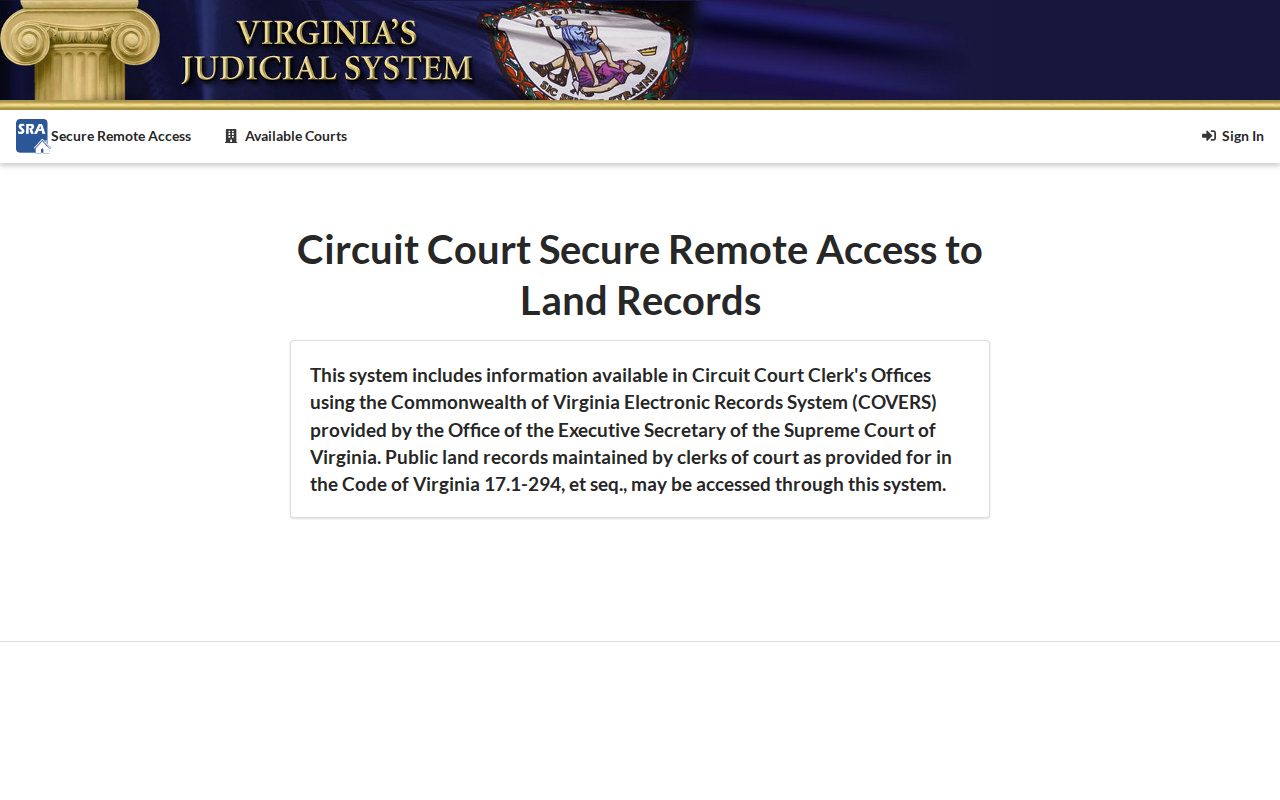
Sometimes the index shows a result while the image stays closed. Write down the book and page or document reference, then ask the Clerk how to view or copy it.
At the Montross Clerk Counter, Match the Legal Description
Anne B. Garner serves as the Westmoreland Circuit Court Clerk. Her office sits at 175 Polk Street, P.O. Box 307, Montross, Virginia 22520, with phone 804-493-0108 and email agarner@vacourts.gov. Posted weekday hours run 9 to 5, though recording stops at 4:30. At the counter you can reach deeds and other land instruments, plats, plus court and probate files tied to a parcel.
Come prepared. Bring the owner spelling, the approximate transfer period, the parcel number, and the legal description. Ask staff about the public terminal, where a book or reel lives, and how images are pulled. Also confirm whether what you need is a land instrument or a separate case file, since a deed reference can point to a partition, foreclosure, or estate action. The county's Land Records page posts current Clerk contact details, and a visit in person helps when an old book or restricted image sits outside the online index.
Westmoreland County Deed Records Reach Beyond the Web Index
The Library of Virginia holds deep Westmoreland material. Its listing covers general deed index reels from 1653 through 1964, plus deed and will books, a subdivision plat index, oyster plat books from 1896 through 1906, and court order and chancery records. These are finding references. They show where a historical chain can be researched, not that every page has an online scan.
For a pre-web transfer, start with the LVA reel range or the original book in the Clerk's Records Room. General Index 1 covers 1653 to 1831. General Index 2 covers 1831 to 1898. Early miscellany volumes carry their own index. The finding aid notes they are not fully included in the general deed index.
Read the Library of Virginia Westmoreland collection guide before selecting a reel. Its catalog notes the historical gaps.
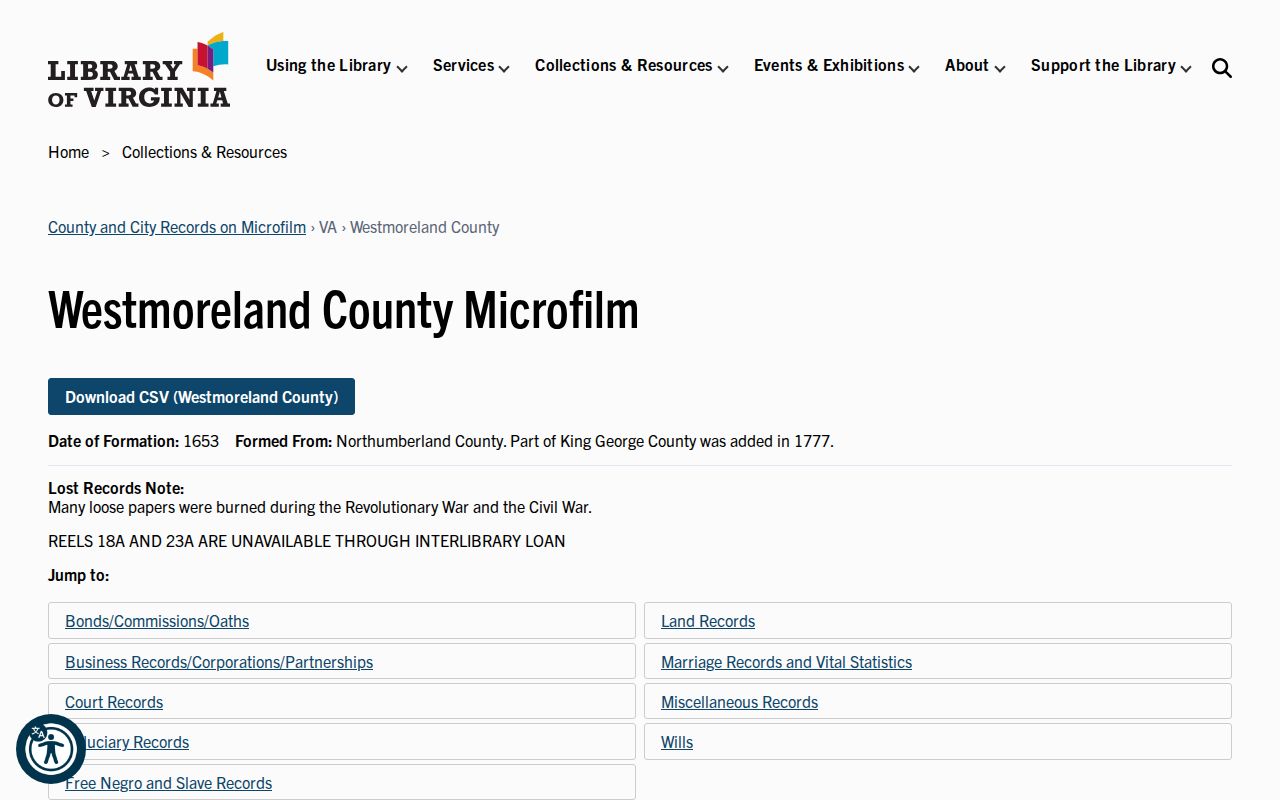
A general name search can fail. Drop to a volume-level index, and preserve the original spelling plus the neighboring index entries in your notes.
Follow a Westmoreland Deed Chain Through Both Parties
A grantor transfers an interest. A grantee receives it. To move backward, start with the most recent deed that matches the parcel, note its grantor and legal description, then search that grantor as a grantee in an older period. A tax-card buyer is not always the recorded grantee. Never assume they match. Read the instrument itself, or request a copy, when the index line is not enough.
- Find the latest vesting deed and confirm its land description.
- Record grantor, grantee, recording date, instrument type, and book/page or document reference.
- Search the prior grantor as a grantee and compare the next description.
- Repeat until the needed time depth, then branch for a probate, trust, partition, or court order transfer.
- Grantor
- The party conveying an interest.
- Grantee
- The party receiving an interest.
- Chain of title
- The linked sequence of recorded instruments affecting a parcel.
- Book/page or document reference
- The locator for the filed record; retain the exact format displayed.
Westmoreland County Deed Records Have a Historic Index Gap
Westmoreland County was formed in 1653 from Northumberland. But its land records reach back further than any online tool. Fires during the Revolutionary War and the Civil War destroyed many loose papers. The LVA finding aid says so. The same aid notes early deed, will, and patent miscellany. These never made it into the general index. So a missing index entry does not mean no conveyance existed. Westmoreland County property records simply have a historic gap in places. Track each branch carefully. When the usual name search stalls, go to the specific deed book and its own volume index. Also use old plat references and probate or chancery material. Descriptions can shift too, from a town lot to metes and bounds. That hides the parcel from a name-based property search. A trustee, executor, spouse, or estate may also stand in as owner of record. This happens where a familiar name should be. Mark which books and images you have already reviewed so the deed records trail stays clear.
Separate Westmoreland Deeds From Security Instruments
A deed of trust or mortgage secures a debt. It is not the conveyance that transfers ownership. Search for later releases or satisfactions, and keep assignments tied to the original reference. Judgments, mechanic's liens, easements, declarations, and lis pendens can all shape property research, yet none carries the legal function of the deed that vested the interest.
Court questions run through the Circuit Clerk's civil file. There you may find a foreclosure, partition, quiet-title request, tax dispute, or estate petition. SRA is the land-record route, not a general docket database. The online case record may show only a docket skeleton, and pleadings or orders may require a terminal or a request to the Clerk.
How to Obtain a Westmoreland County Deed Copy
Check first whether Westmoreland's SRA clerk authorization allows online images under your account. If not, use the reference to ask the Clerk for an in-person image, paper copy, or certified copy. The Clerk FOIA policy says viewing generally carries no charge when only a minimal search is needed. Standard letter-size copies are generally guided at $0.50 per page. Extensive staff time, electronic media, and GIS work may cost actual expense. Ask for an estimate before any broad request.
A Virginia FOIA request must describe records with reasonable specificity. Westmoreland accepts requests by mail, fax, email, in person, or phone. Include the parcel description, parties, date range, book or page if known, and the instrument type. The five-working-day response rule does not promise complete or free copies.
Keep each index result whole. Group the grantor and grantee spellings, instrument description, instrument date, recording date, and volume or document reference. A party name alone is an uncertain match. The legal description separates a deed for the parcel from a similarly named person's record. The referenced book does the same for records elsewhere in the county. A modern parcel may have several older lot descriptions. Follow the separate references before treating the chain as one tract.
For older instruments, add alternate spellings. Include both parties if known, the approximate year, and any volume or page from an index. Westmoreland's older land descriptions may use waterways, adjoining tracts, or former roads. They may not use a modern situs address. A narrow request built on those clues beats asking staff to identify every deed tied to a name.
Recorded is not guaranteed. An index entry identifies a filed instrument, but it is not a title opinion and may not reveal every unrecorded claim. Confirm the chain and any outstanding interests with the appropriate title professional or attorney.
Plan an extensive copy request with the Circuit Court Clerk FOIA policy in hand. Keep certified-copy needs separate from ordinary image viewing.