
Westmoreland County Former Owners by Record Era
Start from the newest deed. Its grantee is the next name to investigate. The Westmoreland Circuit Court Clerk keeps the county's current land records. Virginia's statewide Secure Remote Access service adds an electronic grantor-grantee index for participating records. Treat the portal as a starting point. Ask the Clerk where a particular book or date range is held, since coverage varies by era. Older property history lives elsewhere. The Library of Virginia holds an index and microfilm collections that reward a volume-level approach.
| Source | Years It Covers | Where Held | What It Shows |
|---|---|---|---|
| Virginia SRA grantor-grantee index | Online span not confirmed | State portal and Clerk | Indexed parties, instrument references, and sometimes images |
| Westmoreland deed books and papers | County records begin in 1653; survival varies | Circuit Court Clerk; some microfilm at LVA | Conveyances and other recorded land instruments |
| LVA general deed index | 1653–1964 | Library of Virginia collections | Names and references to indexed deed records |
| Oyster plat books | 1896–1906 | Library of Virginia microfilm | Specialized plats, not a complete ownership chain |
A recent transfer starts in the SRA index. Confirm the record at the Clerk's office. Nineteenth- and early twentieth-century chains take more digging. Use the deed volume or microfilm reel cited by the finding aid alongside the index. Plats show land divisions and boundaries. They cannot, by themselves, establish who owned each resulting lot. Historic tax lists can frame a question. They never substitute for the recorded instrument conveying title. The Library of Virginia's Westmoreland County collection page describes its cataloged materials and reel references. Treat that finding aid as a guide to holdings. It is not a promise that every deed opens online.
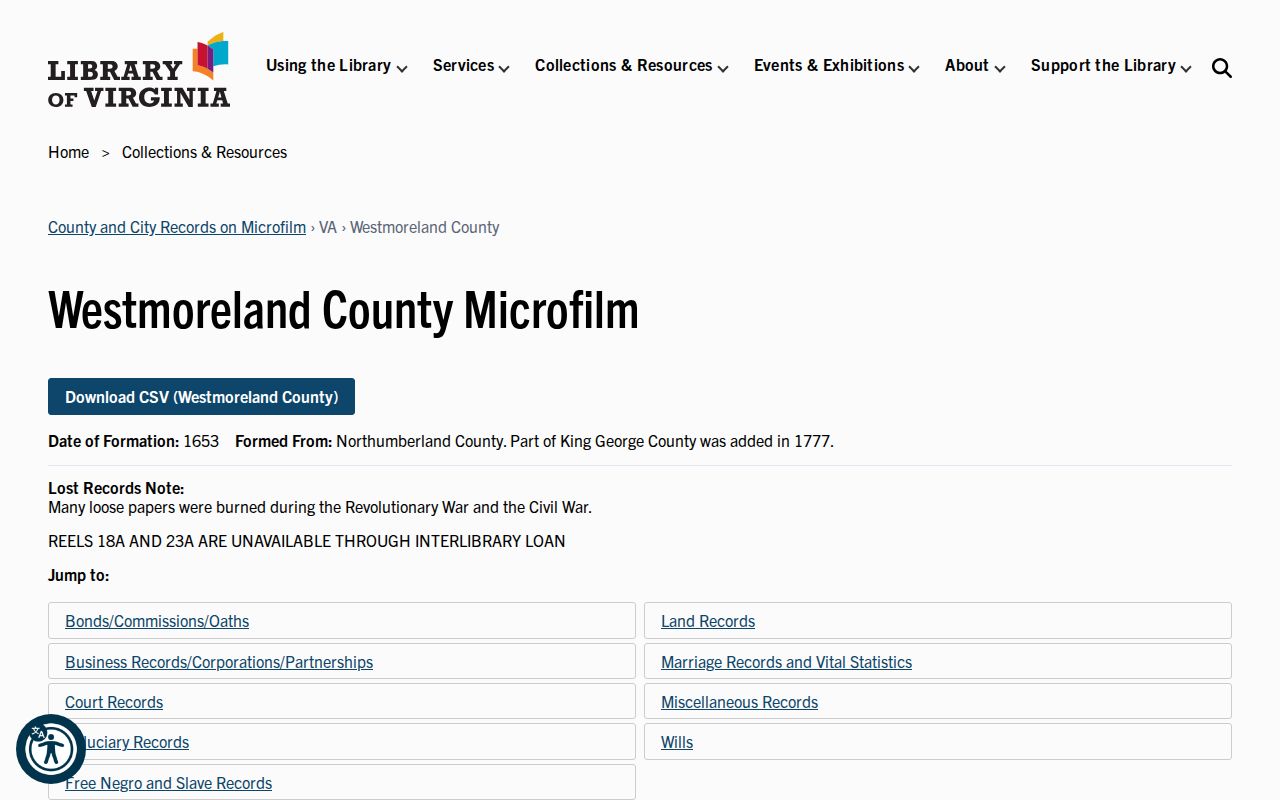
Use the catalog entry to spot a record series or reel. Then check availability and access requirements with the Library or the local Clerk.
Walk the Westmoreland Deed Chain Backward
A deed chain grows one transfer at a time. First pin down the parcel. Use its current parcel number, situs address, and legal description. Then find the latest deed and record the grantee, grantor, instrument date, recording date, and book and page or document number. Search that grantee in earlier records as a grantor. When a matching conveyance appears, keep walking back through its own grantee. Names alone never suffice. People share names, and an owner may convey only part of a tract or an undivided interest.
- Locate the latest matching deed with the current owner named as grantee.
- Read the grantor, legal description, date, and book or document reference from that deed.
- Search the grantor as a grantee in an earlier deed, checking that the parcel description connects.
- Continue backward, and switch to cited deed books, indexes, or microfilm when the online range ends.
- Grantor / grantee
- The parties identified as conveying and receiving an interest in a deed.
- Chain of title
- The ordered sequence of recorded instruments relevant to ownership of a parcel.
- Legal description
- The written land description, often more useful than a modern street address in older records.
Westmoreland Former Owners and the Online Deed Index
Virginia's SRA index is built around grantor and grantee names. Each entry references a recorded instrument. It helps you move backward from a known transfer. The service does not state Westmoreland County's earliest searchable web year. It also does not give the date deed images go online. An index result can sit visible. The image waits behind Clerk authorization, a subscription, or payment. Copy the citation exactly. Include the instrument date, recording date, and book and page or document number. Then ask the Clerk which route supplies the underlying page. Treat the oldest portal result with care. It rarely marks the first deed ever recorded for a tract. Online coverage, indexing coverage, and surviving records are different spans. A former-owner history should name its source and range.
Match Westmoreland Former Owners by Land Description
Older names shift across deeds, indexes, and assessment cards. Search spelling variants and initials freely. Then confirm every candidate against the land description and nearby tract references. One deed may list a person alone. Another names a spouse, trustee, executor, or company. Such shifts can mark a real change in capacity rather than a separate owner with a similar name. Compare acreage, water boundary, road, adjoining owners, and the book reference before adding a transfer. A family transfer, trust conveyance, or inherited undivided interest rarely looks like a plain sale. When two records will not connect, mark the gap. Search related probate or court references instead of trusting the names alone.
Historic Westmoreland Former Owners in Volume Indexes
The Library of Virginia's general index spans 1653 through 1964. There is one catch. The earliest miscellany, 1653 to 1677, sits outside that index. For those first records, use the index attached to the volume itself. Do not rely on a surname search alone. This matters in Westmoreland. The county's earliest land history predates modern street addressing. A description may hinge on a tract name, a creek, a road, or a neighboring owner instead. Boundaries shifted over time too. Westmoreland County was formed in 1653, and part of King George was added in 1777. A historic deed may cite a former jurisdiction or an older watercourse. Record the citation and jurisdiction exactly as written. Never quietly translate an old boundary into a current parcel line.
Use Westmoreland Plats to Follow Former Owners
A plat shows how a big tract became lots. That explains why a later deed covers only a slice of an earlier holding. The Library of Virginia catalog holds oyster plat books dated 1896–1906 plus an undated subdivision plat index. Turn to these when a deed names a subdivision, an oyster ground, or a lot arrangement. A plat gives the layout, not the owners. It never replaces the conveyance instrument itself.
Check the lot number against the recorded deed. Match adjoining streets, the creek or bay, the scale, and the parent tract reference too. Suppose the current parcel merges several historic lots. Then trace each source parcel on its own until the deed chain reveals how they joined. Maps help house history. Legal boundary work still demands the controlling recorded document and, at times, a survey.
Request a Westmoreland Former Owner Record
The Circuit Court Clerk's land-record office sits at 175 Polk Street, PO Box 307. The mailing address is Montross, VA 22520. Hours run Monday through Friday, 9 a.m. to 5 p.m. Recording closes at 4:30 p.m. The telephone number is 804-493-0108. A narrow request travels best. Give the parties, an approximate year, a parcel or tract description, and a book/page reference. Ask instead for every deed tied to a surname. The staff then faces a far heavier task.
The Clerk's published FOIA policy treats simple viewing as generally free when searching stays minimal. Standard paper copies generally run $0.50 per page. Extensive research or special-format work may bring actual costs. Request an estimate before any broad retrieval. Say whether an ordinary copy or a certified copy is what you need. Keep in mind that a response or portal index result is no legal title opinion.
How Far Westmoreland Ownership Records Reach
Westmoreland County dates to 1653. The Library of Virginia's general deed index spans 1653 through 1964, a remarkable research window. Yet it promises no unbroken chain for every parcel. The LVA reports many loose papers lost to fires. These fires occurred in the Revolutionary and Civil War periods. The earliest miscellany, 1653–1677, sits outside the general index. Reach it through the index for the specific volume instead. Older research often hinges on tract descriptions. Former watercourse or road names and neighboring land references matter too. Do not expect a current street address to appear.
Oyster plat books dated 1896–1906 and an undated subdivision plat index round out the collection. They can light up a land division or a local place name. They cannot replace the deed chain. Some reels, including references 18A and 23A, are reported unavailable through interlibrary loan. Confirm access directly before a visit or a request. When an early transfer stays hidden, keep the citations. State the documentary gap plainly rather than filling it by inference.
For a modern indexed deed, the Virginia SRA search portal may show an index entry. Where authorized, it may also show an image. That statewide search interface does not display the county's full historic holdings.
An index hit is only a locator. Confirm the referenced deed, with its legal description and recording details, through the Clerk or an authorized image service.
Use the chain for property history. Former-owner research can support house history, boundary questions, and title work. A name in an old public instrument is not permission to target, threaten, or harass a living person.